Is a Home Warranty Worth It in Utah? What Buyers and Sellers Should Know
A home warranty may be worthwhile when a Utah home has aging appliances or mechanical systems, the buyer has limited money available for unexpected repairs, or a seller wants to provide additional reassurance. However, a home warranty is not automatically a good investment—and it is never a substitute for inspections, maintenance, homeowners insurance, or careful review of the contract.
The phrase “home warranty” can sound more comprehensive than the actual coverage.
In Utah law, a home warranty service contract generally involves an agreement to repair, replace, or reimburse the contract holder for a covered home component, appliance, or system following mechanical or operational failure. It is a service contract—not unlimited protection against everything that could go wrong with the property.
The real question is not simply whether home warranties are good or bad.
The better question is:
Does this specific contract provide meaningful protection for this specific home at a reasonable total cost?
What Does a Home Warranty Usually Cover?
Coverage varies by company and plan.
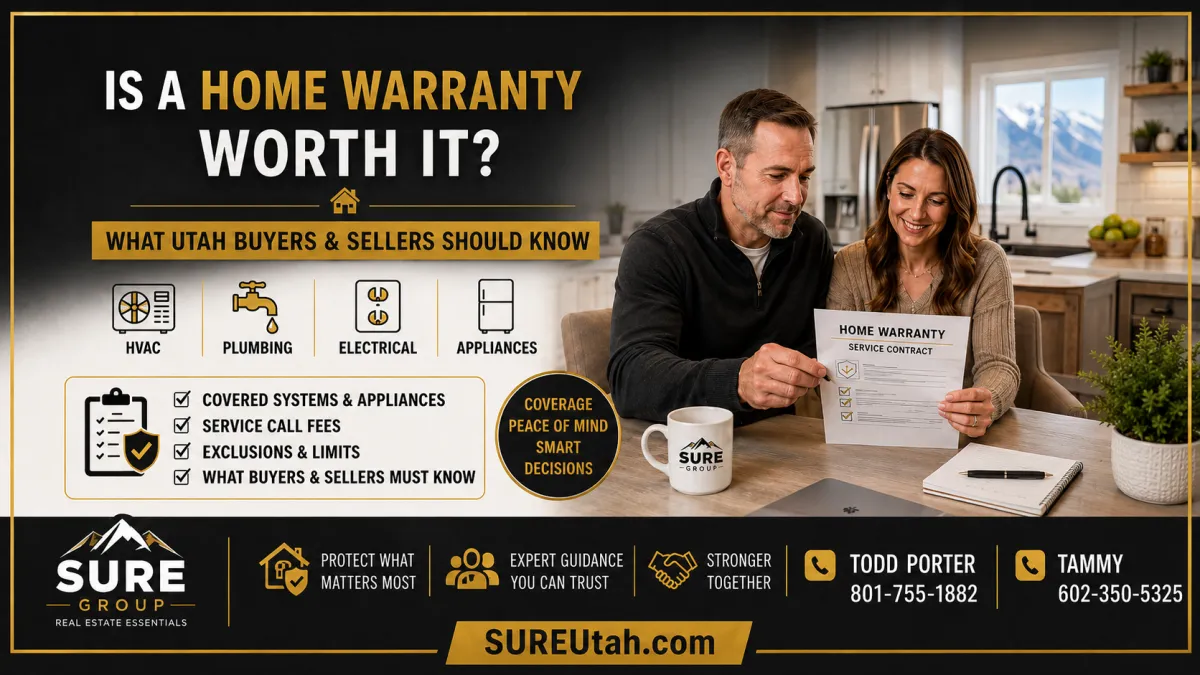
Depending on the contract, coverage may include certain components of:
Heating systems
Central air conditioning
Electrical systems
Plumbing systems
Water heaters
Refrigerators
Ranges and ovens
Dishwashers
Garbage disposals
Built-in microwaves
Garage-door openers
Additional coverage may sometimes be available for items such as pools, spas, secondary refrigerators, septic systems, or well pumps.
Do not assume an item is covered simply because it appears in an advertisement.
The Federal Trade Commission advises consumers to review limits, deductibles, service charges, exclusions, reimbursement caps, maintenance requirements, cancellation terms, and the claims process before purchasing a service contract.
What Does a Home Warranty Commonly Exclude?
The exclusions may matter more than the list of covered items.
Depending on the contract, coverage may be limited or denied because of:
Preexisting conditions
Improper installation
Poor maintenance
Code violations
Cosmetic defects
Rust or corrosion
Structural problems
Roof leaks
Foundation damage
Sewer lines outside the home
Mold or water damage
Manufacturer recalls
Unusual or inaccessible equipment
Permitting or code-upgrade expenses
A contract may cover one component of a system while excluding another.
For example, a plumbing plan might cover a failed interior pipe but exclude the cost of opening and repairing a wall. An HVAC plan might cover a mechanical part but exclude refrigerant, modifications, code upgrades, or equipment that was improperly installed.
If the contract does not clearly say an item is covered, do not assume it is.
The Utah Insurance Department specifically warns consumers that home warranty products may contain restrictive language, exclusions, exceptions, and coverage limitations.
Is a Home Warranty the Same as Homeowners Insurance?
No.
Homeowners insurance generally addresses covered losses caused by events such as fire, wind, theft, vandalism, and certain types of sudden damage.
A home warranty generally focuses on the mechanical or operational failure of specifically covered systems and appliances.
For example:
A furnace damaged by a covered house fire may involve homeowners insurance.
A furnace component that fails because of ordinary mechanical wear may potentially involve a home warranty.
A furnace that fails because it was improperly installed or poorly maintained may be excluded from the home warranty.
Utah buyers should obtain a property-specific insurance quote early and review why homeowners insurance is rising along the Wasatch Front.
A warranty and an insurance policy serve different purposes. One does not replace the other.
When May a Home Warranty Be Worth It for a Buyer?
A home warranty may provide value when:
The home has older systems or appliances
A property with an aging furnace, water heater, dishwasher, or range may present a greater chance of a service request during the first year.
The buyer has limited repair reserves
Closing on a home can consume a significant amount of available cash. A covered repair may be easier to manage through a service fee than through a large unexpected invoice.
The buyer is unfamiliar with local contractors
A warranty company may coordinate a service provider, although the homeowner may have limited control over which contractor is assigned.
The seller is paying for the plan
A seller-paid warranty may provide the buyer with a year of additional protection without increasing the buyer’s upfront expenses.
The contract clearly covers the home’s actual risk areas
Coverage is more meaningful when it applies to the home’s specific equipment without restrictive exclusions or unusually low benefit limits.
When Might a Home Warranty Not Be Worth It?
A home warranty may provide limited value when:
The appliances and systems are relatively new
Manufacturer or builder warranties are still active
The owner has a strong emergency fund
The contract contains broad exclusions
Coverage limits are low
Service fees are high
The homeowner wants to choose their own contractor
Claims require lengthy approval
The property has unusual or specialized equipment
The likely failure involves an excluded condition
The FTC notes that consumers may find a service contract duplicates existing coverage, covers only part of a product, or creates a difficult repair process. The agency also suggests comparing the contract with the alternative of placing money into a dedicated repair savings account.
Can a Home Warranty Replace the Home Inspection?
Absolutely not.
A warranty should never be used as an excuse to reduce due diligence.
The buyer should still investigate:
Roof condition
Foundation
Drainage and grading
Electrical system
Plumbing
Sewer line
Heating and cooling systems
Water heater
Appliances
Radon
Well or septic components when applicable
A home warranty may deny a claim when evidence suggests that a condition existed before coverage began.
That makes the inspection record even more important.
Buyers should also review what radon testing may reveal before closing and, for rural properties, what to know when buying a Northern Utah home with a well or septic system.
Is a Home Warranty Helpful for Utah Sellers?
It can be.
A seller may purchase or provide a home warranty to:
Reduce a buyer’s concern about older systems
Strengthen the overall offer package
Provide additional reassurance after closing
Differentiate the property from competing homes
Reduce conflict when a covered item fails shortly after possession
The Utah Insurance Department notes that Utah’s commonly used Real Estate Purchase Contract includes a section addressing whether a home warranty will be obtained, and that sellers may use a warranty as an incentive for a buyer.
However, a warranty should not be marketed as proof that the home has no defects.
Sellers still need to disclose known material conditions. Buyers still need inspections. The contract still contains limitations.
Questions to Ask Before Purchasing a Home Warranty
Before agreeing to a plan, obtain the complete contract and ask:
Which systems and appliances are covered?
Which parts of those systems are excluded?
What is the service-call fee?
Is there a separate fee for each trade visit?
What are the annual and item-specific payment limits?
Are preexisting conditions excluded?
Is maintenance documentation required?
Who selects the contractor?
Can the owner use an independent contractor?
Is prior authorization required?
Are code upgrades, permits, disposal, and modifications covered?
How are replacement values calculated?
Is the contract transferable?
What is the cancellation policy?
Is the provider authorized to operate in Utah?
Utah consumers can use the state’s official insurance licensee search to check a provider. The Utah Insurance Department says a home warranty product may only be issued, sold, or offered by an authorized insurer or recognized surplus-lines carrier.
A Better Way to Decide
Do not decide based on the word “warranty.”
Compare these four numbers:
The contract price
The service-call fee
The maximum benefit for the system most likely to fail
The amount you could place into a repair reserve instead
Then consider the home’s actual condition.
A $700 plan with a $100 service fee and a low HVAC limit may be less valuable than it initially appears. On the other hand, a seller-paid plan with reasonable limits on an older but functioning home may provide useful short-term protection.
The value is in the contract—not the label.
The Bottom Line
A Utah home warranty can be worthwhile, but it is not automatic protection and it is not free repair coverage.
It may make sense when:
The home contains aging systems
The buyer has limited repair reserves
The seller is paying
The coverage is clear
The limits are reasonable
The provider is reputable and authorized in Utah
It may not make sense when the home has newer equipment, the exclusions are broad, the benefit limits are low, or the homeowner would be better served by building a repair fund.
Read the complete contract. Compare the real cost. Inspect the home. Verify the provider. Then decide.
Frequently Asked Questions About Utah Home Warranties
Is a home warranty required when buying a Utah home?
No. A home warranty is generally optional and may be purchased by the buyer, seller, or another party as negotiated in the transaction.
Who normally pays for the home warranty?
Either party may pay. In some transactions, the seller offers a one-year plan as a buyer incentive.
Does a home warranty cover an old furnace?
Possibly, but coverage depends on the contract, condition, maintenance history, cause of failure, exclusions, and benefit limit.
Does a home warranty cover preexisting problems?
Many contracts exclude preexisting conditions. Buyers should not rely on a warranty to correct defects found during inspection.
Can I choose my own repair contractor?
Not always. Many providers assign contractors and require advance authorization before repairs begin.
Will a home warranty replace an appliance with a new equivalent model?
Not necessarily. The provider may repair the item, offer a limited replacement allowance, provide a depreciated payment, or apply a contractual benefit cap.
Does a home warranty cover a well or septic system?
Only when the plan specifically includes those components or additional coverage is purchased. Limits and exclusions may be substantial.
Where can Utah consumers report a problem?
Consumers may contact the Utah Insurance Department or report suspected fraud and deceptive practices through the Federal Trade Commission.
Considering Buying or Selling a Utah Home?
Todd Porter, known as Utah Todd, and Tammy Swain help buyers and sellers evaluate property condition, inspections, repair risks, contract terms, market value, financing, and the complete real estate strategy.
Todd Porter and Tammy Swain
SURE Group, brokered by Real Estate Essentials
SUREUtah.com
Todd: 801-755-1882
Tammy: 602-350-5325
Real estate is not only an agent’s business, it’s everyone’s business.
This article provides general educational information and is not legal, insurance, tax, or contractual advice. Home warranty plans differ significantly. Review the complete contract and consult qualified professionals before purchasing coverage.