
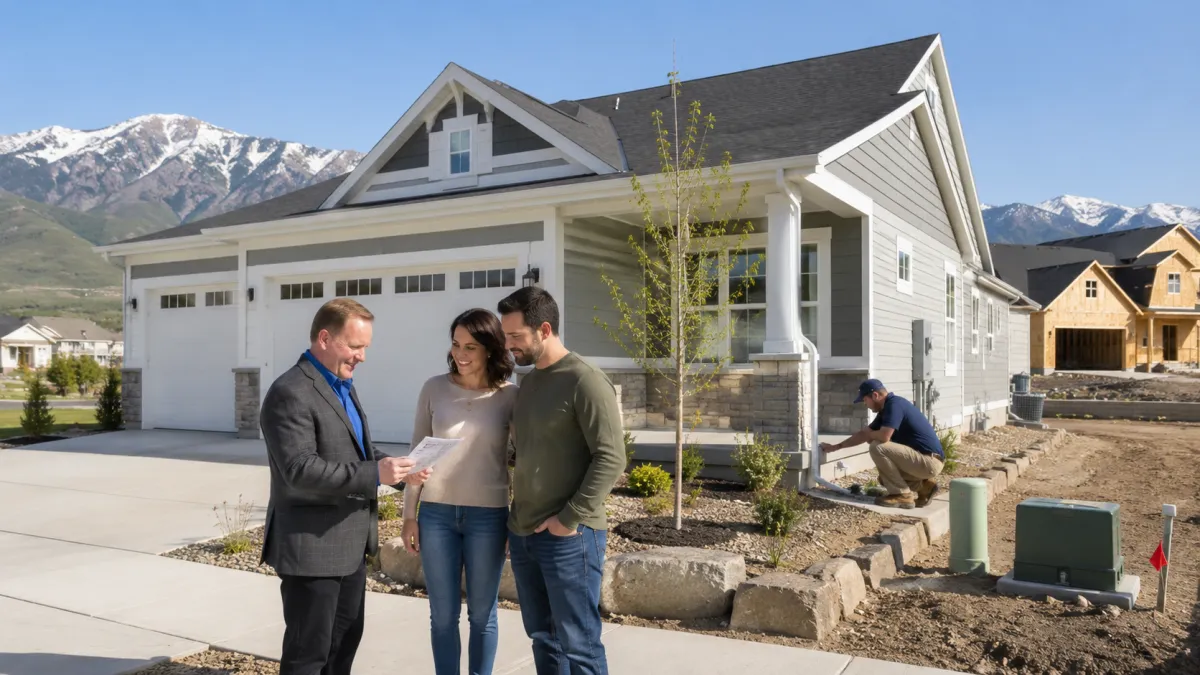
What Should Buyers Know Before Buying a New Build in Utah?
Before buying a new build in Utah, buyers should understand the builder contract, complete purchase price, construction timeline, inspection rights, warranty, HOA rules, lot conditions, future development, financing incentives, and everything the builder does—or does not—include.
A newly built home may offer modern design, new systems, energy efficiency, and fewer immediate remodeling projects. But “brand-new” does not mean risk-free, defect-free, fully finished, or automatically affordable.
The most important step is to slow down before signing.
A model home, temporary financing incentive, or attractive base price can create urgency. Your job is to look beyond the presentation and determine what the completed property will actually cost, how the contract protects you, and whether the neighborhood and home will still serve you several years from now.
Is the Advertised Price the Complete Price?
Usually not.
A builder’s advertised price may represent the base floor plan on a standard lot with limited finishes. Your final price may increase through:
Lot premiums
Structural options
Design-center selections
Cabinet and countertop upgrades
Flooring
Appliances
Lighting
Additional garage space
Finished basement areas
Decks or patios
Landscaping
Fencing
Window coverings
HOA fees
Financing and closing costs
Ask the builder for a written cost summary before committing.
It should identify:
Base price
Lot premium
Structural changes
Selected upgrades
Builder incentives
Lender credits
Closing costs
Items excluded from the purchase
Estimated post-closing improvements
A home that starts at one price may cost substantially more once it is ready for normal family life.
The earlier guide Should I Buy New Construction in Davis County? provides a broader look at pricing, inspections, contracts, incentives, and warranties.
What Should I Know About the Builder Contract?
Builder contracts are often written by the builder and may be very different from the standard forms buyers see in resale transactions.
The contract may control:
Whether deposits are refundable
Construction deadlines
Allowable delays
Material substitutions
Price adjustments
Inspection access
Financing requirements
Appraisal shortages
Buyer cancellation rights
Builder cancellation rights
Design deadlines
Change-order costs
Closing procedures
Warranty claims
Arbitration or dispute resolution
Do not assume the contract protects you in the same way as a traditional resale purchase agreement.
Utah’s Department of Commerce provides an optional residential construction agreement intended as a starting resource for residential construction negotiations. The state specifically advises both parties to read, understand, complete, and sign the agreement carefully. A production builder may use a separate proprietary contract with different terms.
Have unclear legal provisions reviewed by a qualified Utah real estate attorney before you become noncancelable.
How Can I Research the Builder?
Research the company—not just the model home and salesperson.
Utah’s Construction Business Registry allows consumers to search for licensed construction professionals and verify contractor information.
Review:
Contractor-license status
Business name and ownership
Completed communities
Homes that are several years old
Warranty procedures
How complaints are handled
Construction quality
Communication after closing
Any available disciplinary history
Talk with owners in completed phases when possible.
Ask practical questions:
Were deadlines reasonably accurate?
Were problems corrected?
How responsive was warranty service?
Did the finished home match the contract?
Were there unexpected costs?
How has the home performed after two or three winters?
A polished sales experience does not necessarily reveal what happens after closing.
Do I Need an Independent Inspection on a New Home?
Yes.
Building-department inspections and private buyer inspections serve different purposes.
Davis County requires building permits for new construction and regulated structural, electrical, plumbing, gas, and mechanical work within its jurisdiction.
That public process does not replace an independent inspection performed for the buyer.
A private inspector may identify issues involving:
Framing
Roof installation
Attic insulation
Grading
Drainage
Concrete
Windows and doors
Plumbing fixtures
Electrical components
Heating and cooling
Appliances
Safety items
Incomplete work
Cosmetic defects
Depending on construction progress and your contract rights, consider:
Pre-drywall inspection
This occurs after major framing and internal systems are installed but before walls conceal them.
Final inspection
This occurs near completion and before closing.
Warranty-period inspection
This may occur before the builder’s initial warranty period expires, allowing the homeowner to document concerns that became visible after living in the home.
Do not allow the phrase “it passed city inspection” to end the conversation.
What Is a Final Walk-Through—and Is It an Inspection?
A final walk-through is not the same as a professional home inspection.
The walk-through is your opportunity to confirm that:
Contracted work is complete
Selected finishes were installed
Appliances operate
Doors and windows function
Surfaces are not damaged
Agreed corrections were completed
The property is reasonably clean
Landscaping and exterior work match the agreement
Create a detailed written list rather than relying on verbal promises.
Photograph problems and record the location of each one. Confirm who will complete the work and whether it will be finished before closing or handled through the warranty process.
Whenever possible, verify repairs before signing final closing documents.
What Should I Know About the Builder Warranty?
Ask for the complete written warranty early—not after closing.
Review:
Covered items
Exclusions
Coverage periods
Cosmetic-item deadlines
Structural coverage
Appliance coverage
Required homeowner maintenance
Claim-submission procedures
Repair timelines
Arbitration requirements
Transferability to a future buyer
Do not rely on general statements such as “everything is covered for a year.”
Different components may have different terms and reporting deadlines.
Keep:
The signed warranty
Inspection reports
Walk-through lists
Emails
Photos
Repair requests
Builder responses
Maintenance records
Submit warranty concerns through the required written system. Conversations with a superintendent or salesperson may not satisfy the formal claim procedure.
Should I Use the Builder’s Preferred Lender?
The preferred lender may offer meaningful incentives, but compare the entire loan.
Possible incentives include:
Closing-cost credits
Interest-rate buydowns
Discounted lender fees
Design-center credits
Appliance packages
Extended rate locks
Compare that offer with at least one independent lender using the same:
Loan type
Down payment
Lock period
Interest rate
Discount points
Mortgage insurance
Fees
Seller or builder credits
A large builder incentive may be partly offset by a higher rate, additional points, or less favorable loan costs.
Evaluate the long-term loan—not just the advertised credit.
What Should I Know About the Lot?
The floor plan can be changed more easily than the lot.
Before selecting a homesite, investigate:
Slope
Drainage
Sun direction
Backyard depth
Side-yard width
Driveway grade
Retaining walls
Utility boxes
Streetlights
Fire hydrants
Mailbox locations
Traffic patterns
Nearby common areas
Future roads
Adjacent construction
Whether future homes may block views
Walk the actual lot at different times of day.
A premium lot may not be worth the added cost when it faces strong afternoon sun, backs to a future road, has a difficult slope, or provides less usable yard than expected.
Never assume an open field or view will remain unchanged. Review the development plan, zoning, recorded plat, and future phases.
What Should I Know About the HOA?
Many Utah new-build communities include a homeowners association.
Before closing, review:
Current dues
Services included
Rules and restrictions
Rental limitations
Parking rules
RV and trailer restrictions
Fence requirements
Landscaping standards
Pet rules
Architectural controls
Reserve information
Insurance
Pending assessments
Developer control
Planned amenities
When homeowners take control
Utah’s Department of Commerce publishes an HOA homebuyer checklist encouraging buyers to review fees, governing documents, reserves, insurance, meeting information, restrictions, and potential assessments before closing.
Introductory HOA dues may not reflect the long-term cost after the developer completes the community and transfers control.
Should I Ask About Radon During Construction?
Yes.
Utah’s Department of Environmental Quality reports that approximately one in three Utah homes tested has elevated radon levels. Radon cannot be seen, smelled, or tasted; testing is the only way to determine a home’s level.
Ask whether the builder includes:
Radon-resistant construction
Passive vent piping
A location for a future fan
Sealed foundation penetrations
A post-completion radon test
Utah DEQ provides guidance specifically for installing radon-control systems during new-home construction.
Adding radon-resistant features during construction may be simpler than retrofitting later.
What Is Not Included in the New Home?
Get a written list.
Common exclusions may include:
Refrigerator
Washer and dryer
Window coverings
Backyard landscaping
Fencing
Sprinklers
Deck or patio
Water softener
Garage-door opener
Basement finish
Radon system
Internet wiring
Exterior lighting
Certain mirrors or fixtures
Model homes are designed to create an emotional reaction. Many displayed features may be upgrades or decorator items that are not included in the standard home.
Ask the salesperson to walk through the model and identify, room by room, what is standard, upgraded, optional, or not included.
What Should Buyers Know About Construction Delays?
Estimated completion dates are not always guaranteed.
Delays can result from:
Weather
Labor shortages
Utility connections
Material availability
Inspections
Change orders
Financing
Permit timing
Subcontractor scheduling
Buyers with a lease ending, military transfer, school deadline, or existing home sale need a backup housing plan.
Review the contract carefully to determine:
Whether the completion date is binding
What delays are allowed
Whether the buyer receives notice
Who pays rate-lock extension fees
Whether the buyer can cancel after a major delay
How closing is scheduled
Do not make irreversible moving plans based solely on an informal estimate.
How Should I Compare a New Build With a Resale Home?
Compare the completed cost—not simply the list prices.
A resale home may already include:
Mature landscaping
Finished fencing
Window coverings
Appliances
Finished basement space
Storage
Patio or deck
Established neighborhood amenities
A new home may provide:
Modern design
New systems
Builder warranty
Energy efficiency
Finish selections
Fewer immediate remodeling needs
The article Is New Construction or a Resale Home Better in Utah? explains those tradeoffs in greater detail.
Should You Buy the New Build?
A new build may make sense when:
The completed payment is comfortable
The location fits your commute
The lot works for your household
You understand the contract
The builder has a credible record
Inspection rights are protected
The warranty is clear
HOA rules fit your lifestyle
You have budgeted for excluded items
You can tolerate construction around you
Pause when:
The price depends on incentives you do not understand
The contract limits important protections
The payment requires financial stretching
The lot has unresolved concerns
The builder will not provide documents
The timeline is critical but uncertain
Major completion costs remain unfunded
Buyers considering different local developments can review What Are the Best Davis County Cities for New-Construction Homes?
Ready to Evaluate a Utah New Build?
Todd Porter, known as Utah Todd, and Tammy Swain can help you compare builders, contracts, lots, incentives, inspections, warranties, financing, HOA documents, resale alternatives, and the complete cost of the home.
Frequently Asked Questions
Should I bring an agent when visiting a new-home community?
Yes. Establish representation before the first visit. Some builders require the buyer’s agent to accompany or register the buyer at the initial appointment.
Can I negotiate with a builder?
Possibly. Builders may negotiate through financing credits, upgrades, lot premiums, appliances, landscaping, or completed-inventory discounts rather than lowering the recorded sales price.
Is a certificate of occupancy the same as a home inspection?
No. A certificate of occupancy confirms that the jurisdiction has approved occupancy under applicable requirements. It does not replace an independent inspection performed for the buyer.
Should I test a brand-new Utah home for radon?
Yes. Utah DEQ states that testing is the only way to determine the radon level, and elevated levels have been found in a substantial share of Utah homes.
Final Thoughts
Buying a new build can be exciting, but the strongest buyers remain disciplined.
They verify the builder. They read the contract. They compare lenders. They inspect the home. They investigate the lot. They understand the HOA. They review the warranty. They budget for everything excluded from the purchase.
Most importantly, they compare the completed home and total ownership cost—not the model home and advertised starting price.
A new home should provide a strong foundation for your life, not a collection of expensive surprises after closing.
Todd Porter, known as Utah Todd, and Tammy Swain are real estate agents with SURE Group, brokered by Real Estate Essentials, helping buyers, military families, relocating families, first-time buyers, and move-up homeowners throughout Davis County, the Wasatch Front, and Northern Utah.
Todd Porter — Utah Todd
801-755-1882
[email protected]
Tammy Swain
602-350-5325
[email protected]
Real estate is not only an agent’s business, it’s everyone’s business.