
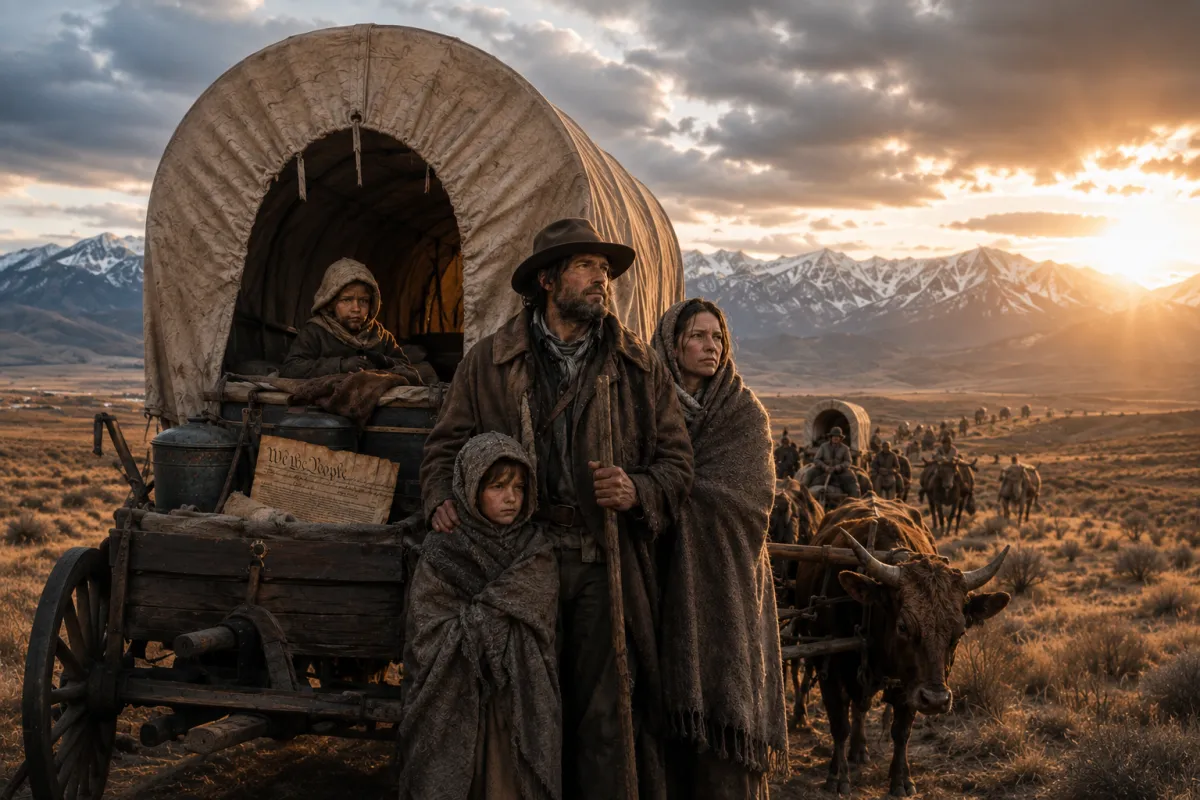
Why Did the Mormon Pioneers Come to Utah? The Constitution, Joseph Smith, and the Fight for Life, Liberty, and Property
In 1838, the United States already had a Constitution.
It had a First Amendment protecting religious exercise and the right to petition the government.
It had a Fifth Amendment declaring that no person should be deprived of life, liberty, or property without due process of law.
And yet, on October 27, 1838, Missouri Governor Lilburn W. Boggs issued an executive order directing state forces to treat the Latter-day Saints as enemies. The order said they had to be “exterminated or driven from the state” if necessary.
Read that again.
An American governor used the power of government against an entire religious community.
Families were forced from their homes.
Property was stolen, destroyed, or abandoned.
Men, women, and children crossed rivers in freezing weather. They lived in temporary camps. They buried family members along the trail.
They appealed to courts.
They petitioned governors.
They went to Congress.
They even appealed to the president of the United States.
The Constitution promised rights. But when those families needed protection, government officials told them there was little or nothing they could do.
That failure is one of the biggest reasons the Mormon pioneers eventually came to Utah.
They were looking for more than open land.
They were looking for a place where life, liberty, religious freedom, and property ownership could mean something in practice.
The Pioneer Story Is a Constitutional Story
Most Pioneer Day stories begin with covered wagons entering the Salt Lake Valley on July 24, 1847.
That is the end of the journey.
To understand why the pioneers came to Utah, you have to start with the failure of constitutional government to protect them.
The First Amendment says Congress cannot prohibit the free exercise of religion. It also protects the right of citizens to petition government for relief.
The Fifth Amendment protects life, liberty, and property from federal action without due process.
Those words sound powerful.
But during the 1830s and 1840s, the Bill of Rights was generally understood to restrict the federal government, not state governments. In Barron v. Baltimore in 1833, the United States Supreme Court ruled that the Bill of Rights did not apply directly to the states. The Fourteenth Amendment, which later became the constitutional basis for applying most Bill of Rights protections against state governments, would not be adopted until 1868.
That legal gap mattered.
Missouri could violate the very principles Americans associated with religious liberty, due process, and property rights, while federal officials claimed they lacked jurisdiction to intervene.
A right without a remedy is a promise on paper.
The Latter-day Saints learned that the hard way.
What Happened to the Latter-day Saints in Missouri?
The Missouri conflict was complicated.
There were disputes over religion, politics, voting power, land, business, immigration, and local control. Armed groups formed on both sides, and Latter-day Saint forces also committed acts of violence during the 1838 conflict.
But the government’s response did not focus on prosecuting individual crimes.
It targeted a people.
Governor Boggs issued Executive Order 44 after violence had escalated between Latter-day Saints, local residents, and Missouri militia forces. His order called for the Saints to be expelled from Missouri or exterminated if deemed necessary.
Three days later, an armed group attacked the Latter-day Saint settlement at Haun’s Mill. Men and boys were killed.
Thousands of church members eventually fled Missouri.
Many left behind farms, homes, livestock, tools, crops, and businesses. These were not minor inconveniences. In an agricultural society, losing land and livestock could mean losing your ability to feed your family.
Property was survival.
Slavery Was Already Part of the Missouri Conflict
Missouri was a slave state.
Many Latter-day Saints had moved there from northern states. Their growing numbers made some Missourians fear that they could eventually influence elections, local government, and slavery policy.
In 1833, a church newspaper published an article concerning free Black people and Missouri law. Although church leaders tried to explain that they were not encouraging migration into Missouri, local opponents accused the Saints of interfering with enslaved people and encouraging Black settlement.
That perception contributed to mob action and the expulsion of church members from Jackson County. A mob destroyed the church’s printing office and tarred and feathered local leaders.
That history matters because slavery wasn’t a side issue.
Fear over race, slavery, migration, and political power followed the Latter-day Saints long before Joseph Smith became a presidential candidate.
The Saints Took Their Case to the United States Government
After leaving Missouri, church members collected sworn statements describing murders, assaults, property losses, and forced removal.
They petitioned Congress for redress.
One memorial appealed directly to constitutional duty:
“The constitution, you are sworn to support, alike guarantees to every citizen, the humblest in society, the enjoyment of life, liberty and property.”
They weren’t asking for special rights.
They were asking the government to protect rights Americans already claimed were fundamental.
Joseph Smith and Elias Higbee also met with President Martin Van Buren.
According to a near-contemporary account, Van Buren responded that he could do nothing because helping them would bring him into conflict with the State of Missouri. Joseph later summarized the response more bluntly: “Your cause is just, but I can do nothing for you.”
Congress didn’t provide the requested relief either.
The Senate Judiciary Committee concluded that the federal government lacked jurisdiction and directed the petitioners back toward Missouri’s courts, the very system they said had already failed them.
Think about what that meant.
Their cause could be just.
Their losses could be real.
Their constitutional argument could be morally sound.
And they could still be left without protection.
That experience changed Joseph Smith’s view of American government.
Joseph Smith Ran for President Because the System Had Failed
Joseph Smith announced his candidacy for president of the United States in 1844.
His campaign was not simply a publicity stunt.
He had asked existing political leaders what they would do to protect religious minorities from mob violence. Their answers disappointed him. He had petitioned government institutions and received little relief.
So he presented his own program.
His presidential platform addressed federal power, mob violence, criminal justice, banking, government spending, public lands, Native relations, territorial expansion, and slavery.
At the center of his message was a basic question:
What good is the Constitution if government cannot protect a lawful minority from organized violence?
Joseph believed the federal government needed enough power to protect citizens when state governments refused or failed to act.
That position made him more than a religious leader.
It made him a political threat.
Was Joseph Smith an Abolitionist?
By 1844, yes.
That answer needs some context.
Joseph Smith’s views on slavery developed over time. In 1836, after church members had already suffered violence in Missouri partly because they were suspected of abolitionist sympathies, he distanced himself from the immediate abolitionist movement.
His later position became much stronger.
As a presidential candidate in 1844, Joseph proposed that the federal government end slavery throughout the United States by 1850. His plan called for compensated emancipation, funded partly through the sale of federal public lands and reductions in congressional pay.
He called on the nation to:
“Break off the shackles from the poor black man.”
He also attacked the contradiction between America’s Declaration of Independence and the existence of millions of enslaved people. How could the country declare that all people were created equal while holding human beings in bondage because of the color of their skin?
His proposal differed from the immediate, uncompensated abolition demanded by leaders such as William Lloyd Garrison.
But the goal was unmistakable.
End slavery nationally.
Do it within six years.
Use federal action to accomplish it.
That was an abolitionist presidential position.
Was Abolition a Reason Joseph Smith Was Killed?
It was a significant part of the political climate that made Joseph Smith dangerous to his enemies.
It should not be presented as the only cause.
Joseph was no longer just leading a church. By 1844, he was:
Mayor of Nauvoo
Leader of a rapidly growing religious movement
Commander of the Nauvoo Legion
Head of a large and organized voting population
Candidate for president of the United States
Advocate for stronger federal protection of religious minorities
A presidential candidate publicly calling for an end to slavery
In a country moving toward a national crisis over slavery, that combination mattered.
His followers had already been accused in Missouri of threatening the slave system. Now Joseph was openly calling for national emancipation and sending campaign representatives across the country. His antislavery platform added to the fear that his religious, military, and political influence could grow beyond Illinois.
It is reasonable to view abolition as one significant factor in the hostility surrounding him. That is an inference supported by his platform, the earlier Missouri conflict, and the political fear surrounding his growing movement.
The immediate crisis that led to his arrest and murder involved more.
Former church members published the Nauvoo Expositor, accusing Joseph of plural marriage, abuse of power, and attempts to create a theocracy. The Nauvoo City Council declared the newspaper a public nuisance, and the press was destroyed.
Joseph was first charged with riot and later with treason after declaring martial law and calling out the Nauvoo Legion.
On June 27, 1844, an armed mob attacked Carthage Jail and killed Joseph Smith and his brother Hyrum.
So, did they kill Joseph Smith solely because he opposed slavery?
The surviving evidence does not prove that.
Did his abolitionist presidential campaign help make him appear more politically powerful, dangerous, and unacceptable to his enemies?
Yes. It belongs in the story.
Leaving it out removes a major part of what Joseph was publicly fighting for during the final months of his life.
The Murder of Joseph Smith Pushed the Saints Toward the West
After Joseph and Hyrum were killed, hostility did not disappear.
Violence continued around Nauvoo. Homes and farm buildings were burned. Pressure grew for the Latter-day Saints to leave Illinois.
By February 1846, families began crossing the Mississippi River.
Their destination was not yet a state called Utah. The Great Salt Lake region was then part of Mexican territory. Their goal was to move beyond the established boundaries of the United States and create a place where they could govern their communities and practice their religion with less interference.
The Mormon Pioneer National Historic Trail stretches roughly 1,300 miles from Nauvoo, Illinois, to the Great Salt Lake Valley.
The 1846 crossing of Iowa was brutal. Rain turned roads into deep mud. People suffered from hunger, disease, cold, and exhaustion. Temporary settlements were created along the route so later companies could find food and shelter.
The first major pioneer company entered the Salt Lake Valley in July 1847. Brigham Young arrived on July 24, the date Utah now commemorates as Pioneer Day. Nearly 70,000 Latter-day Saint emigrants followed the trail between 1847 and the arrival of the transcontinental railroad era.
Utah Was Not Empty
The pioneers entered a harsh and sparsely settled valley, but they did not enter an empty land.
Ute, Shoshone, Goshute, Paiute, and Navajo peoples had lived throughout the region for generations. The Salt Lake Valley served as a buffer and travel area between Native groups, and settlement eventually affected Native water, food sources, trade, movement, and sovereignty.
That part of the history should be told plainly.
The Latter-day Saints knew what it meant to lose homes, property, and security.
As their settlements expanded, Native people also lost access to land and resources.
Honoring pioneer courage doesn’t require pretending the land had no history before 1847.
A strong people should be able to tell a complete story.
The Pioneers Built Because They Wanted Something Government Had Failed to Give Them
When the pioneers reached the Salt Lake Valley, they began digging irrigation ditches, planting crops, building shelter, laying out streets, and preparing for winter.
They had crossed the plains because they wanted room to live their beliefs and build stable communities.
They wanted homes no mob could casually take.
They wanted land they could work.
They wanted local government that would protect them rather than drive them out.
They wanted the promise of the Constitution to become part of daily life.
Utah did not become a state immediately. That happened on January 4, 1896, almost 49 years after the first pioneer company entered the valley. Utah’s state constitution and admission into the Union placed the territory fully inside the constitutional system the pioneers had once fled to escape.
There is something powerful about that.
They left because government had failed them.
Their descendants eventually helped create a state government operating under the Constitution of the United States.
Pioneer Day Is About More Than Wagons
Pioneer Day is a story about faith and endurance.
It is also a warning.
A Constitution cannot protect anyone if government officials are unwilling to honor it.
Religious liberty matters most when the religion is unpopular.
Free speech matters most when the message is offensive to those in power.
The right to petition matters most when government would rather ignore the petition.
Due process matters most when a crowd has already decided someone is guilty.
Property rights matter most when powerful people want to take what belongs to someone else.
The pioneers learned every one of those lessons.
They lost homes in Missouri.
They lost businesses and farms.
They lost the protection of local government.
They lost Joseph and Hyrum Smith to a mob while the brothers were being held in a government jail.
Then they walked west and started again.
What Does This Mean for Utah Homeowners Today?
You do not have to descend from a pioneer to understand the value of ownership.
Look at the communities along the Wasatch Front today.
Bountiful.
North Salt Lake.
Farmington.
Kaysville.
Layton.
Families build lives here because a home provides more than four walls.
It creates stability.
It gives a family a place to gather.
It can protect against rising housing costs.
It can build equity.
It can become an inheritance.
It can give the owner choices.
Property rights are not an old political slogan. They affect what you can build, what you can keep, what you can pass down, and how much control you have over your future.
That is why I take ownership seriously.
A Home Is More Than a Transaction
I’m Todd Porter, also known as Utah Todd.
I’m a Davis County real estate strategist, REALTOR®, investor-minded advisor, educator, and founder of Synergy United Real Estate Group, also known as SURE Group.
My roots are in Davis County. My work reaches across the Wasatch Front and into the Wasatch Back.
I help Utah buyers and sellers protect equity, reduce risk, understand the market, and make real estate decisions with a long-term strategy.
I don’t believe a home is just a structure.
It is where families are raised.
It is where values are passed down.
It is where stability and wealth can begin.
The pioneers came west after losing almost everything because they understood something we sometimes forget.
Ground matters.
Ownership matters.
The right to build, protect, and pass property forward matters.
So this Pioneer Day, ask yourself a hard question.
If everything familiar were stripped away tomorrow, would you have what it takes to keep walking?
And while you still have the freedom to build something worth protecting, what are you doing with it?
Frequently Asked Questions About the Mormon Pioneers, the Constitution, and Joseph Smith
Why did the Mormon pioneers come to Utah?
The Mormon pioneers came west after years of persecution, property loss, government inaction, and forced removal in Missouri and Illinois. They wanted an isolated place where they could worship, organize communities, own property, and live with greater security.
Did Missouri really issue an extermination order against Mormons?
Yes. Missouri Governor Lilburn W. Boggs issued Executive Order 44 on October 27, 1838. It directed state forces to treat the Latter-day Saints as enemies and called for their extermination or removal if necessary. Missouri formally rescinded the order in 1976.
Why didn’t the United States Constitution protect the Latter-day Saints?
The Constitution expressed principles of religious liberty, due process, petition, and property protection. But before the Fourteenth Amendment, the federal Bill of Rights was generally interpreted as restricting the federal government, not state governments. Federal officials also claimed they lacked jurisdiction to remedy Missouri’s actions.
Was Joseph Smith an abolitionist?
By 1844, Joseph Smith publicly supported ending slavery throughout the United States. His presidential plan called for slavery to be phased out by 1850 through compensated emancipation funded partly by the sale of federal lands. His earlier views had been more cautious, so his position developed over time.
Was Joseph Smith killed because he opposed slavery?
His abolitionist presidential platform was one significant factor that increased his political threat. It was not the only cause documented in the historical record. His murder followed a broader conflict involving religion, politics, Nauvoo’s power, plural marriage, internal dissent, the destruction of the Nauvoo Expositor, martial law, and treason charges.
How far did the Mormon pioneers travel?
The federally recognized Mormon Pioneer National Historic Trail covers approximately 1,300 miles from Nauvoo, Illinois, to the Great Salt Lake Valley.
When did Utah become a state?
Utah became the 45th state on January 4, 1896.
Author and Contact Information
Todd Porter, also known as Utah Todd
REALTOR® and Utah Real Estate Strategist
Founder and CEO, Synergy United Real Estate Group | SURE Group
Davis County first. Wasatch Front reach. Wasatch Back influence.
Website: www.SUREUtah.com
Email: [email protected]
Phone: 801-755-1882
Todd Porter helps Utah buyers, sellers, move-up families, luxury homeowners, and wealth-building buyers protect equity, reduce risk, and make strategic real estate decisions. His positioning centers on local authority, property rights, ownership, and long-term wealth building.