
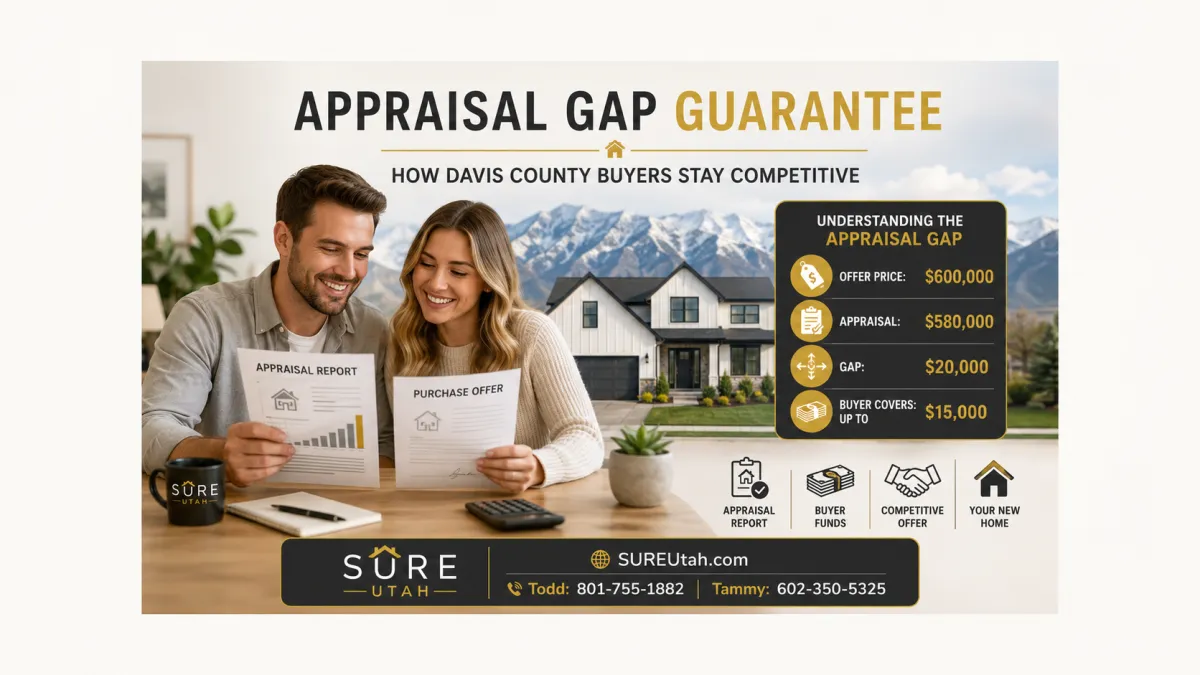
Appraisal Gap Guarantee in Utah: What Davis County Buyers Should Know
An appraisal gap guarantee can strengthen a Davis County offer by promising that the buyer will cover some or all of the difference between the purchase price and a lower appraised value. But the guarantee must be specific, financially realistic, and coordinated with the buyer’s loan terms and other contract protections.
A strong appraisal-gap provision should answer five questions:
How much of the shortfall will the buyer cover?
Is there a maximum dollar limit?
Which appraisal controls?
What happens if the shortfall exceeds the limit?
How does the guarantee interact with financing, earnest money, and due-diligence deadlines?
The goal is not simply to make the offer sound aggressive. The goal is to make it clear, credible, and enforceable without committing the buyer to more cash than the buyer can safely provide.
What Is an Appraisal Gap?
An appraisal is an independent opinion of a property’s value. Mortgage lenders commonly use the appraisal to evaluate the property supporting the loan. The Consumer Financial Protection Bureau explains that an appraisal is a written opinion of value and may include information about the home and comparable properties in the neighborhood.
Suppose a Davis County buyer offers $600,000, but the lender’s appraisal comes in at $580,000. The appraisal gap is $20,000.
The lender does not necessarily reduce the purchase price. Instead, the lender generally calculates the loan using the lower supported value, subject to the specific loan program and underwriting requirements. The buyer and seller must then determine how to handle the difference.
Possible outcomes may include:
The seller lowers the price
The buyer contributes more cash
The parties split the difference
The buyer requests a reconsideration of value
The transaction ends if the contract permits cancellation
Fannie Mae identifies similar options after a low appraisal, including negotiating a lower price, increasing the buyer’s cash contribution, requesting a reconsideration of value, or potentially walking away depending on the sales contract.
What Is an Appraisal Gap Guarantee?
An appraisal gap guarantee is a buyer’s written promise to cover a defined difference between the agreed purchase price and the appraised value.
It can be structured in several ways:
Full gap guarantee
The buyer agrees to complete the purchase at the full contract price regardless of the appraised value, subject to any other remaining contract rights.
This is the most aggressive approach and potentially the most financially dangerous.
Capped gap guarantee
The buyer agrees to cover the shortfall up to a stated maximum.
Example: The buyer agrees to cover an appraisal shortfall of up to $15,000.
Minimum-value structure
The buyer agrees to pay the contract price as long as the appraisal is not below a stated value.
Example: The buyer offers $600,000 and agrees not to request a price reduction if the appraisal is at least $585,000.
Percentage-based guarantee
The buyer agrees to cover a percentage of the shortfall, sometimes with a maximum dollar amount.
This can work, but a fixed cap is often easier for everyone to understand.
What the Written Provision Should Address
An appraisal gap should not be communicated only through a text message, verbal promise, or vague statement that the buyer will “make up the difference.” Utah agreements involving the purchase and sale of real property should be documented in writing and signed.
The exact wording should be prepared or approved by a licensed Utah real estate professional or attorney based on the transaction. Conceptually, the addendum should identify:
The agreed purchase price
The appraisal being referenced
The buyer’s maximum additional cash commitment
Whether the seller must reduce the price when the gap exceeds the cap
Whether the buyer may cancel if the parties cannot resolve the remaining difference
The deadline for resolving the appraisal issue
The effect on earnest money
Whether other financing protections remain in place
A clear capped structure might communicate the following idea:
The buyer agrees to contribute additional cash at closing equal to the difference between the purchase price and the lender’s appraised value, up to a maximum of $15,000. If the difference exceeds $15,000, the parties may renegotiate the purchase price, and the buyer retains only the cancellation rights specifically stated in the contract and addendum.
That is an educational example—not ready-to-sign legal language. The final provision must fit the current Utah contract, deadlines, loan, and negotiation.
Do Not Confuse a Gap Guarantee With Waiving the Appraisal
These strategies are not identical.
A buyer may:
Keep the appraisal condition and negotiate after a low value
Guarantee only a limited amount of the gap
Set a minimum acceptable appraised value
Waive some appraisal-related protections
Remove the appraisal protection entirely
A capped guarantee usually exposes the buyer to less risk than an unlimited waiver.
However, even a limited gap can create serious consequences when the buyer lacks enough verified cash to cover the down payment, closing costs, reserves, and guaranteed shortfall.
Confirm the Cash Before Writing the Offer
Before offering an appraisal gap, buyers should speak directly with their lender and calculate:
Required down payment
Closing costs and prepaid expenses
Emergency reserves
Maximum appraisal-gap cash
Any lender-required reserves
How a lower appraisal changes the loan-to-value ratio
Do not assume that money originally intended for the down payment can automatically be redirected to the gap without affecting loan approval.
Military buyers should also understand how the loan structure changes the offer. Review the VA assumable loan advantage near Hill AFB when comparing traditional financed offers with an existing assumable mortgage.
Use a Cap That Matches the Property and Market
The strongest offer is not always the offer with the largest gap.
A responsible cap should consider:
Recent comparable sales
How far the offer is above supported value
Property condition
Competing-offer activity
The buyer’s available cash
Expected resale horizon
Whether the home has unusual features
A buyer who guarantees $30,000 over appraised value is not automatically gaining $30,000 in immediate equity. The buyer is choosing to pay more than the appraiser’s supported value because the home has strategic, emotional, or long-term value to that buyer.
Protect Due Diligence
An appraisal gap should not silently replace every other buyer protection.
The buyer may still need to evaluate:
Inspection findings
Roof and major systems
Sewer condition
Insurance cost
Title issues
Radon
HOA documents
Well or septic systems
Review what Davis County buyers should know about radon before closing. Buyers considering older systems should also read whether a home warranty is worth it in Utah.
A competitive offer should be deliberate—not reckless.
What If the Appraisal Appears Wrong?
A buyer may be able to request a reconsideration of value through the lender when the appraisal appears unsupported, inaccurate, or deficient.
Useful information may include:
More appropriate comparable sales
Incorrect square footage or bedroom count
Missing upgrades
Incorrect property characteristics
Unsupported adjustments
Relevant sales that closed after the appraisal was prepared
Fannie Mae requires lenders to maintain a borrower-initiated reconsideration-of-value process for applicable loans. A reconsideration is not a guarantee that the value will change, and the buyer should not rely on an appeal as the only financial plan.
Common Appraisal Gap Mistakes
Writing an unlimited guarantee without enough cash
This can put the buyer’s financing and earnest money at risk.
Using vague language
“Buyer will cover the appraisal” does not clearly identify the amount, calculation, or remedy.
Ignoring financing consequences
A low appraisal can change the down payment, mortgage insurance, loan-to-value ratio, and approval.
Assuming the seller must reduce the price
The seller’s obligation depends on the written contract.
Failing to coordinate deadlines
Appraisal, financing, due diligence, and earnest-money deadlines must work together.
Overpaying solely to win
Winning the offer is not a victory when the payment, cash requirement, or resale risk no longer makes sense.
The Bottom Line
An appraisal gap guarantee can make a Davis County offer more competitive, but only when it is precise and affordable.
A strong provision should:
Define the appraisal shortfall
Set a maximum buyer contribution
Identify the controlling appraisal
Explain what happens above the cap
Coordinate with financing and earnest money
Preserve only the protections the buyer intentionally keeps
Do not promise unlimited cash to make an offer look strong. Use a defined strategy that the buyer can actually perform.
Frequently Asked Questions About Appraisal Gap Guarantees
Is an appraisal gap guarantee required in Utah?
No. It is a negotiated offer strategy, not a general requirement.
Does the buyer always have to pay the appraisal gap?
Only when the written contract requires it and the stated conditions are met.
Can the buyer cap the guarantee?
Yes. A maximum dollar cap is one of the clearest ways to limit exposure.
Does an appraisal gap guarantee remove the financing condition?
Not automatically. The interaction depends on the complete written contract and loan approval.
Can a buyer use gift funds for the gap?
Possibly, but the lender must confirm that the funds and documentation satisfy the loan program.
What happens when the gap exceeds the buyer’s cap?
The outcome depends on the addendum. The parties may renegotiate, the seller may reduce the price, or the buyer may have a stated cancellation right.
Can an appraisal be challenged?
Yes. A borrower may request a reconsideration of value through the lender when credible errors, omissions, or better comparable sales exist.
Will paying an appraisal gap create instant equity?
Not necessarily. The buyer is paying more than the supported appraised value, and future market performance is not guaranteed.
Writing a Competitive Davis County Offer?
Todd Porter, known as Utah Todd, and Tammy Swain help buyers evaluate price, comparable sales, appraisal exposure, financing, inspection risk, earnest money, and the complete offer strategy.
Todd Porter and Tammy Swain
SURE Group, brokered by Real Estate Essentials
SUREUtah.com
Todd:801-755-1882
Tammy:602-350-5325
Real estate is not only an agent’s business, it’s everyone’s business.
This article provides general educational information and is not legal, lending, appraisal, or financial advice. Contract language, deadlines, financing requirements, and available remedies depend on the transaction. Buyers should consult their licensed Utah real estate professional, lender, and attorney when appropriate.