
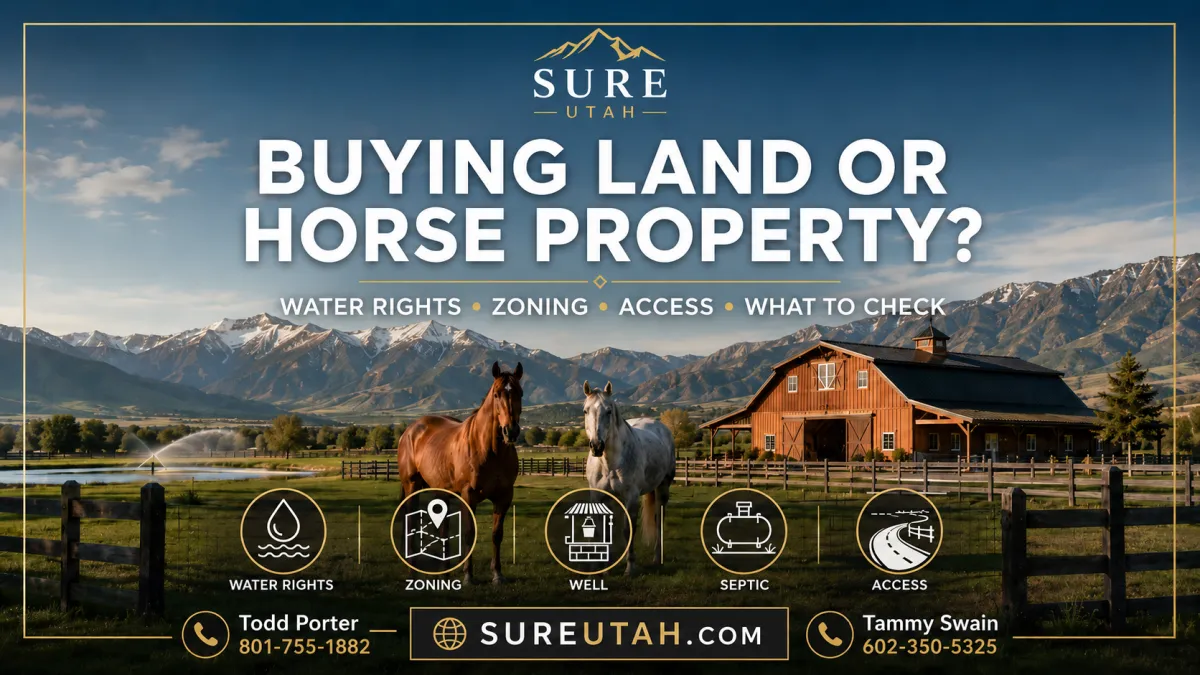
Buying Land or Horse Property in the Wasatch Back: What to Check
Buying acreage or horse property in the Wasatch Back requires more investigation than buying a typical subdivision home. A parcel can look ideal and still have serious limitations involving water, zoning, animal rights, access, septic approval, building sites, easements, or winter maintenance.
The views, open space, barns, pastures, and privacy may be extraordinary. But buyers should not rely on appearance, acreage, or a listing description alone.
The central question is not merely, “Do I like this land?”
It is:
Can I legally and practically use this property the way I intend?
Start With the Intended Use
Before reviewing a parcel, define exactly what you hope to do.
Possible plans may include:
Keeping horses or livestock
Building a primary residence
Constructing a barn, arena, shop, or accessory dwelling
Operating a small agricultural or equestrian business
Creating pasture or irrigated acreage
Subdividing the land later
Using the property seasonally
Holding the land for future development
A property suitable for two recreational horses may not be suitable for boarding, breeding, training, events, or commercial use.
Likewise, land that allows a residence may still restrict the number, location, or size of accessory structures.
Verify the Exact Zoning District
Do not assume that every rural-looking parcel allows horses.
Wasatch Back zoning can vary by county, municipality, planning district, subdivision, and even recorded development agreement.
Summit County uses separate development codes for the Snyderville Basin and Eastern Summit County. The county’s official development-code page explains which code applies to each planning area.
Buyers should obtain written answers from the applicable planning department regarding:
The current zoning designation
Whether horses and livestock are permitted
Animal-unit or acreage requirements
Required setbacks from homes, wells, roads, and property lines
Barn, arena, corral, manure-storage, and fencing rules
Commercial boarding or training restrictions
Accessory dwelling and guesthouse rules
Short-term rental restrictions
Future subdivision potential
Summit County also provides property and zoning resources through its official property-information page.
For Wasatch County parcels, use the county’s official online county code and confirm the interpretation directly with the planning office.
Understand the Difference Between Water Access and a Water Right
Water is one of the most important—and most misunderstood—parts of a rural Utah purchase.
A stream, ditch, pond, spring, well, or irrigation pipe on the property does not automatically mean the buyer owns a valid right to use that water.
The Utah Division of Water Rights maintains documentary files for water rights throughout the state. Buyers can research records through the official water-right records search.
Before relying on a claimed water right, investigate:
The water-right number
The current owner of record
The authorized source
The permitted place and type of use
The priority date
The quantity or beneficial use
Whether the right is active, approved, perfected, or subject to conditions
Whether the water has actually been used
Whether the right will transfer with the real estate
Whether a separate deed or ownership update is required
The Utah Division of Water Rights warns buyers to research carefully and understand both water rights and physical water access before purchasing. Review the agency’s official Buying, Selling and Transferring Water Rights guide.
Confirm the Physical Delivery of Water
A valid paper right is not the same as reliable delivery.
For irrigation water, buyers should ask:
Which ditch or irrigation company delivers it?
Are shares included?
What are the annual assessments?
When is water available?
Who maintains the ditch, headgate, pipe, or lateral?
Are there rotation schedules or shortages?
Does the water actually reach the property?
Are easements recorded for the delivery system?
For culinary or livestock wells, confirm the well log, production, water quality, pump condition, permitted use, and whether the well can support the intended residence and animals.
Our guide to buying a Northern Utah home with a well or septic system explains why buyers should test the water, inspect the equipment, and verify permits before closing.
Investigate Septic Feasibility Before Assuming You Can Build
Vacant land is not necessarily buildable land.
A parcel may require soil testing, a percolation evaluation, an approved septic design, and sufficient space for both the initial system and replacement area.
Important questions include:
Has the property received septic approval?
When were the tests completed?
Are they still valid?
What type of system is required?
How much will installation cost?
Does the proposed home site interfere with the septic area?
Are groundwater, slope, or soil conditions limiting?
A specialized engineered system can cost considerably more than a conventional septic system.
Check Legal and Year-Round Access
A visible road does not guarantee legal access.
Confirm:
Recorded access to a public road
Private-road easements
Road-maintenance agreements
Winter snow-removal responsibility
Emergency-vehicle access
Gate rights
Bridge or culvert condition
Whether the road meets building-permit standards
Mountain and rural roads can become very different during mud season, storms, or heavy snow.
Drive the access more than once and ask who pays when the road, culvert, or bridge needs major work.
Review Easements, Utilities, and Boundary Evidence
Order a current title commitment and review all exceptions.
Rural properties may contain:
Irrigation ditches
Utility easements
Shared driveways
Livestock access
Public-trail rights
Pipeline or transmission corridors
Conservation easements
Access benefiting neighboring parcels
A professional boundary survey may be especially valuable when fences, barns, corrals, roads, or water systems are near the apparent property line.
Do not assume that an existing fence marks the legal boundary.
Inspect the Equestrian Improvements
A beautiful barn may still require major work.
Inspect:
Foundation and structure
Roofing
Electrical service
Water supply
Ventilation
Drainage
Stalls and doors
Hay storage
Fire separation
Manure management
Fencing and gates
Arena footing
Confirm whether barns, arenas, shops, apartments, and additions were permitted.
A home warranty generally does not solve major rural-property issues or guarantee coverage for specialized equipment. Review whether a home warranty is worth it in Utah before assuming it will cover wells, pumps, barns, or equestrian systems.
Evaluate Wildfire, Flood, and Insurance Concerns
Mountain and acreage properties may face insurance challenges involving wildfire exposure, long emergency-response distances, private roads, older roofs, outbuildings, wood heat, and water sources.
Obtain a property-specific insurance quote before the due-diligence deadline.
Read why homeowners insurance is rising along the Wasatch Frontbefore estimating the monthly payment.
Also investigate flood zones, drainage channels, wetlands, steep slopes, avalanche exposure, and geologic hazards when relevant.
Calculate the Full Ownership Cost
Acreage can create expenses that do not appear in a standard subdivision budget.
Include:
Fencing and gate repair
Road and snow maintenance
Well and pump service
Septic maintenance
Irrigation assessments
Pasture improvement
Weed and pest control
Barn and arena maintenance
Equipment and fuel
Insurance
Animal care
Privacy and space have real value, but they also create responsibilities.
The Bottom Line
Land and equestrian properties in the Wasatch Back can provide an exceptional lifestyle—but buyers must investigate the property as a complete operating system.
Before purchasing, verify:
Zoning and animal rights
Water-right ownership and physical delivery
Well production and water quality
Septic feasibility
Legal and winter access
Easements and boundaries
Permits for improvements
Insurance and hazard exposure
The full cost of maintaining the land
Do not buy acreage based only on the view. Buy it only after confirming that the land can legally, physically, and financially support the life you plan to build there.
Frequently Asked Questions About Wasatch Back Land and Horse Property
Does acreage automatically allow horses?
No. The zoning district, animal-unit rules, setbacks, subdivision restrictions, and recorded agreements control what is permitted.
Does a water right automatically transfer with the land?
Not always. Ownership, deed language, state records, irrigation shares, and transfer documents must be reviewed.
Can I drill a well anywhere on rural land?
No. Well approval depends on water rights, state requirements, local rules, and physical conditions.
How do I know whether vacant land can support a septic system?
Obtain current soil and septic evaluations from the applicable health or permitting authority before relying on buildability.
Can I operate a horse-boarding business on residential-agricultural land?
Possibly, but commercial boarding, training, events, and arenas may require additional approvals or a conditional-use permit.
Should I order a survey?
A survey is often valuable when boundaries, fences, roads, barns, ditches, or access easements are important to the purchase.
What is the biggest rural-property mistake?
Assuming that existing use proves legal rights. Verify zoning, water, access, permits, and easements independently.
Should I obtain insurance before making an offer?
At minimum, obtain an early property-specific quote before the due-diligence deadline because rural risks and outbuildings can affect availability and cost.
Considering Land or Horse Property in the Wasatch Back?
Todd Porter, known as Utah Todd, and Tammy Swain help buyers evaluate acreage, water, zoning, access, property condition, market value, and the complete rural-property strategy.
Todd Porter and Tammy Swain
SURE Group, brokered by Real Estate Essentials
SUREUtah.com
Todd:801-755-1882
Tammy:602-350-5325
Real estate is not only an agent’s business, it’s everyone’s business.
This article provides general educational information and is not legal, engineering, water-right, zoning, agricultural, environmental, insurance, or financial advice. Rules and property conditions vary by parcel. Consult the appropriate county, municipality, Utah Division of Water Rights, title company, surveyor, engineer, lender, insurer, and attorney before purchasing.